
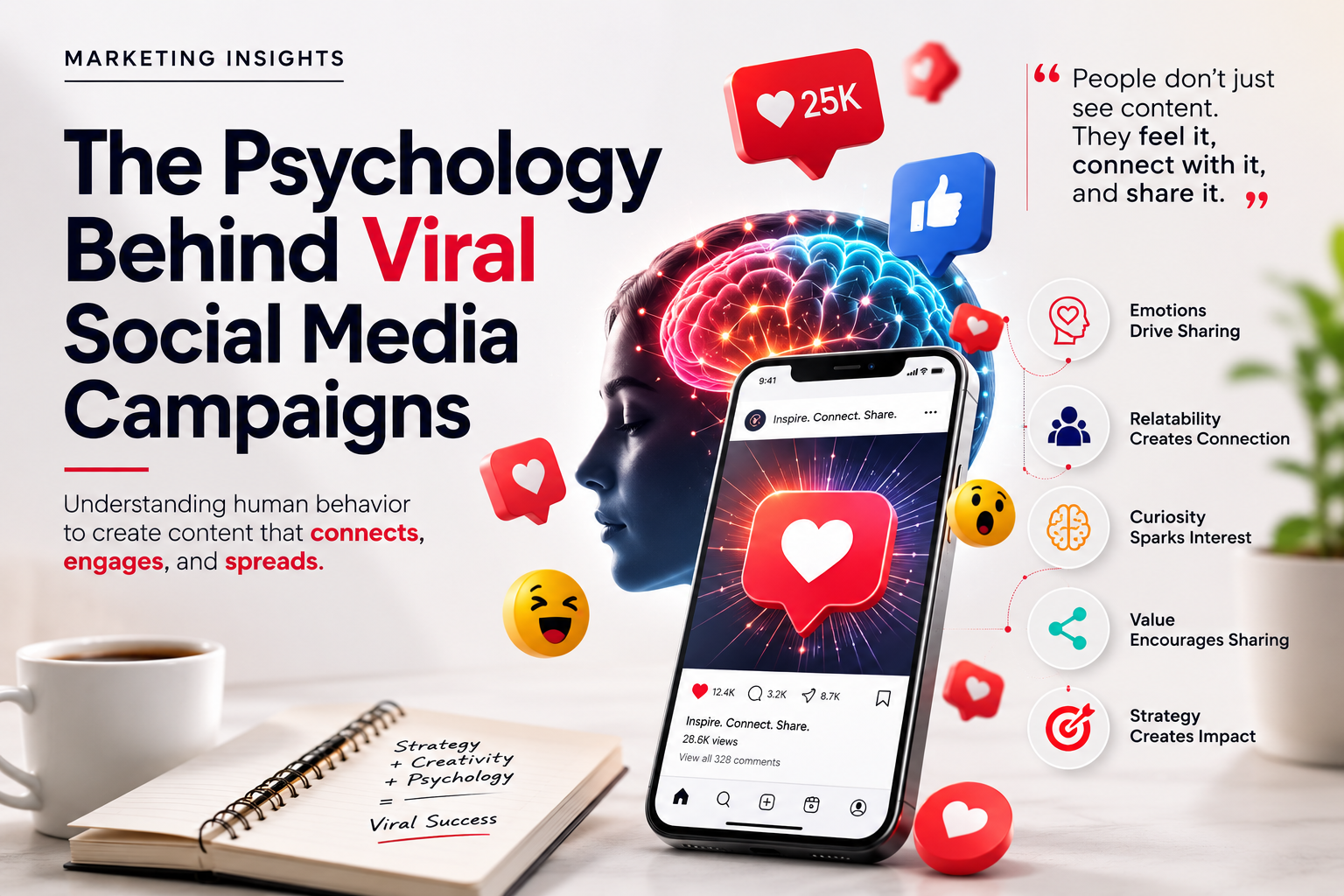
In today’s digital world, millions of social media posts compete for attention every single day. Yet only a small percentage manage to break through the noise, generate massive engagement, and spread rapidly across platforms.
So, what makes a social media campaign go viral?
The answer is not simply luck, a large advertising budget, or perfect timing. Behind most successful viral campaigns lies a deep understanding of human psychology. People share content because it makes them feel something, strengthens their identity, connects them with others, or gives them social value.
Understanding these psychological triggers can help brands create social media campaigns that are more memorable, engaging, and shareable.
What Is a Viral Social Media Campaign?
A viral social media campaign is a piece of branded content or a coordinated marketing initiative that spreads rapidly from person to person through shares, reposts, comments, mentions, and conversations.
Unlike traditional advertising, where a brand pays to distribute a message, viral content gains momentum because audiences actively choose to pass it along.
Virality can happen on platforms such as Instagram, TikTok, YouTube, Facebook, LinkedIn, X, and other digital communities. While no formula can guarantee that a campaign will go viral, certain psychological principles consistently increase the likelihood that people will notice, remember, and share content.
1. Emotion Drives Sharing
Emotion is one of the strongest forces behind viral content.
People rarely share content because it is simply informative. They are more likely to share something that makes them feel excitement, joy, surprise, inspiration, amusement, curiosity, or even anger.
High-arousal emotions encourage action. A funny video may make someone immediately send it to a friend. An inspiring story may motivate people to repost it. A surprising fact may trigger discussion in the comments.
The key lesson for brands is simple: don’t just ask, “What information do we want to communicate?” Ask, “What do we want the audience to feel?”
When content creates a strong emotional response, audiences become more likely to engage with it and spread it organically.
2. Social Currency: People Share What Makes Them Look Good
People often share content that says something positive or interesting about who they are.
This concept is known as social currency. When someone shares a clever advertisement, an exclusive discovery, a useful tip, or an emerging trend, they may feel that it makes them appear informed, entertaining, creative, or ahead of others.
Successful campaigns give people a reason to say:
- “You need to see this.”
- “I discovered this before everyone else.”
- “This perfectly represents me.”
- “This is exactly what I believe.”
Brands can increase social currency by creating content that is surprising, exclusive, useful, culturally relevant, or identity-driven.
The more valuable people feel when sharing your content, the greater its potential to travel.
3. Relatability Creates Instant Connection
One of the most powerful reactions on social media is:
“This is so me.”
Relatable content succeeds because people see their own experiences, frustrations, habits, relationships, or aspirations reflected in it.
This is why memes, workplace humor, relationship content, customer struggles, and everyday observations often achieve high engagement.
For brands, relatability requires a deep understanding of the target audience. Instead of speaking only about products and features, brands should talk about the real situations their customers experience.
For example, a productivity app could focus on the frustration of opening a laptop to work and suddenly spending 30 minutes checking notifications. A coffee brand could create content around the universal feeling of not wanting to speak to anyone before the first morning coffee.
When people recognize themselves in content, engagement becomes natural rather than forced.
4. Surprise Breaks the Pattern
The human brain naturally pays attention to unexpected information.
On social media, users continuously scroll through similar images, videos, headlines, and advertisements. Content that breaks this predictable pattern has a better chance of stopping the scroll.
Surprise can come from:
- An unexpected visual
- A surprising statistic
- An unusual collaboration
- A dramatic transformation
- An unexpected ending
- A clever twist
- A bold creative concept
However, surprise should support the campaign’s message rather than exist purely as a gimmick.
The most effective viral campaigns combine unexpected creativity with clear brand relevance.
5. Curiosity Keeps People Watching
Humans naturally want to close information gaps. When we know part of a story but not the complete answer, curiosity encourages us to keep watching, reading, or clicking.
This psychological principle is often called the curiosity gap.
Effective social media hooks might include:
- “Most brands make this mistake without realizing it.”
- “What happened next surprised everyone.”
- “There’s a reason this campaign generated millions of views.”
- “Can you spot what’s unusual about this advertisement?”
The goal is not to mislead people with clickbait. The content must eventually deliver genuine value or a satisfying answer.
When curiosity is combined with a strong payoff, it can significantly improve watch time, retention, and engagement.
6. Identity and Belonging Encourage Participation
People naturally want to belong to communities and groups that reflect their interests, values, lifestyles, professions, or aspirations.
Viral campaigns often allow audiences to express identity through participation.
Someone might share a campaign because it represents:
- Their profession
- Their generation
- Their hometown
- Their hobbies
- Their lifestyle
- Their personal values
- A community they belong to
This is particularly powerful when campaigns encourage user-generated content, challenges, hashtags, or personal stories.
Instead of treating audiences as passive viewers, successful brands invite them to become part of the campaign itself.
7. Simplicity Makes Content Easier to Share
The best viral ideas are often surprisingly simple.
If people need several minutes to understand the concept, they are less likely to share it. Strong viral campaigns usually have a clear message that can be understood almost immediately.
A simple campaign has three advantages:
It is easy to understand, easy to remember, and easy to explain to someone else.
Brands should avoid trying to communicate too many messages in one campaign. One strong idea is usually more powerful than five competing messages.
The audience should quickly understand what the content is about and why it matters.
8. Storytelling Makes Campaigns Memorable
Humans are naturally drawn to stories.
Facts provide information, but stories provide meaning. A good story creates characters, conflict, emotion, curiosity, and resolution.
Brands can use storytelling by showing:
- A customer’s transformation
- A real human struggle
- The journey behind a product
- An unexpected challenge
- A meaningful brand mission
- A humorous everyday situation
The strongest brand stories don’t make the product the hero. Instead, they make the audience or customer the hero, while the product helps them achieve a desired outcome.
When audiences emotionally invest in a story, they are more likely to remember and share it.
9. Timing and Cultural Relevance Matter
Even excellent content can fail if it arrives at the wrong moment.
Viral campaigns often connect with what people are already discussing. This could include cultural moments, trending formats, seasonal events, major entertainment releases, internet conversations, or changes in consumer behavior.
However, brands should be careful when participating in trends. Forcing a brand into an unrelated conversation can feel inauthentic.
The best question to ask is not:
“How can we use this trend?”
Instead, ask:
“Does our brand have something relevant and valuable to contribute to this conversation?”
Speed matters, but relevance matters more.
10. Participation Turns Audiences Into Distributors
Traditional advertising speaks to an audience. Viral campaigns often invite the audience to respond.
Challenges, polls, duets, remixes, templates, reactions, contests, and user-generated content give people an active role.
When participation is simple and rewarding, audiences become voluntary distributors of the campaign.
The best participation mechanics are:
- Easy to understand
- Quick to complete
- Fun or meaningful
- Flexible enough for creativity
- Naturally connected to the brand
Every new participant potentially introduces the campaign to a completely new network of people.
The Role of Algorithms in Virality
Psychology explains why people engage, while algorithms influence how far content travels.
Social media platforms often consider signals such as watch time, completion rate, shares, saves, comments, rewatches, and early engagement.
However, brands should avoid creating content only for algorithms. Platforms and ranking systems constantly evolve, while fundamental human motivations remain more stable.
The strongest approach is to create content that genuinely captures attention and provides enough emotional, social, or practical value for people to interact with it.
When human psychology and platform mechanics work together, the chances of wider distribution increase.
Can Brands Guarantee Virality?
No brand can guarantee that a campaign will go viral.
Virality depends on many factors, including audience behavior, timing, competition, cultural context, platform distribution, and sometimes pure unpredictability.
However, brands can significantly improve their chances by building campaigns around proven psychological triggers.
Before launching a social media campaign, ask:
- Does it create a strong emotional response?
- Is it relatable to the target audience?
- Does it contain something surprising or unexpected?
- Is there a compelling reason to keep watching?
- Does sharing it provide social value?
- Can people participate easily?
- Is the core idea simple and memorable?
- Is it relevant to the current cultural moment?
The more strongly a campaign answers these questions, the greater its potential for organic reach.
Final Thoughts
The psychology behind viral social media campaigns is ultimately the psychology of human connection.
People share content because it makes them laugh, think, feel, discover, belong, express themselves, or connect with someone else. The most successful campaigns understand these motivations and build experiences around them.
Instead of asking, “How do we make this go viral?”, brands should ask a better question:
“Why would a real person care enough to share this with someone else?”
That shift in perspective can transform ordinary social media content into something genuinely memorable and shareable.
Virality can never be guaranteed, but when creativity, emotion, relevance, simplicity, and human psychology come together, a campaign has a much better chance of moving beyond views and becoming part of the conversation.