
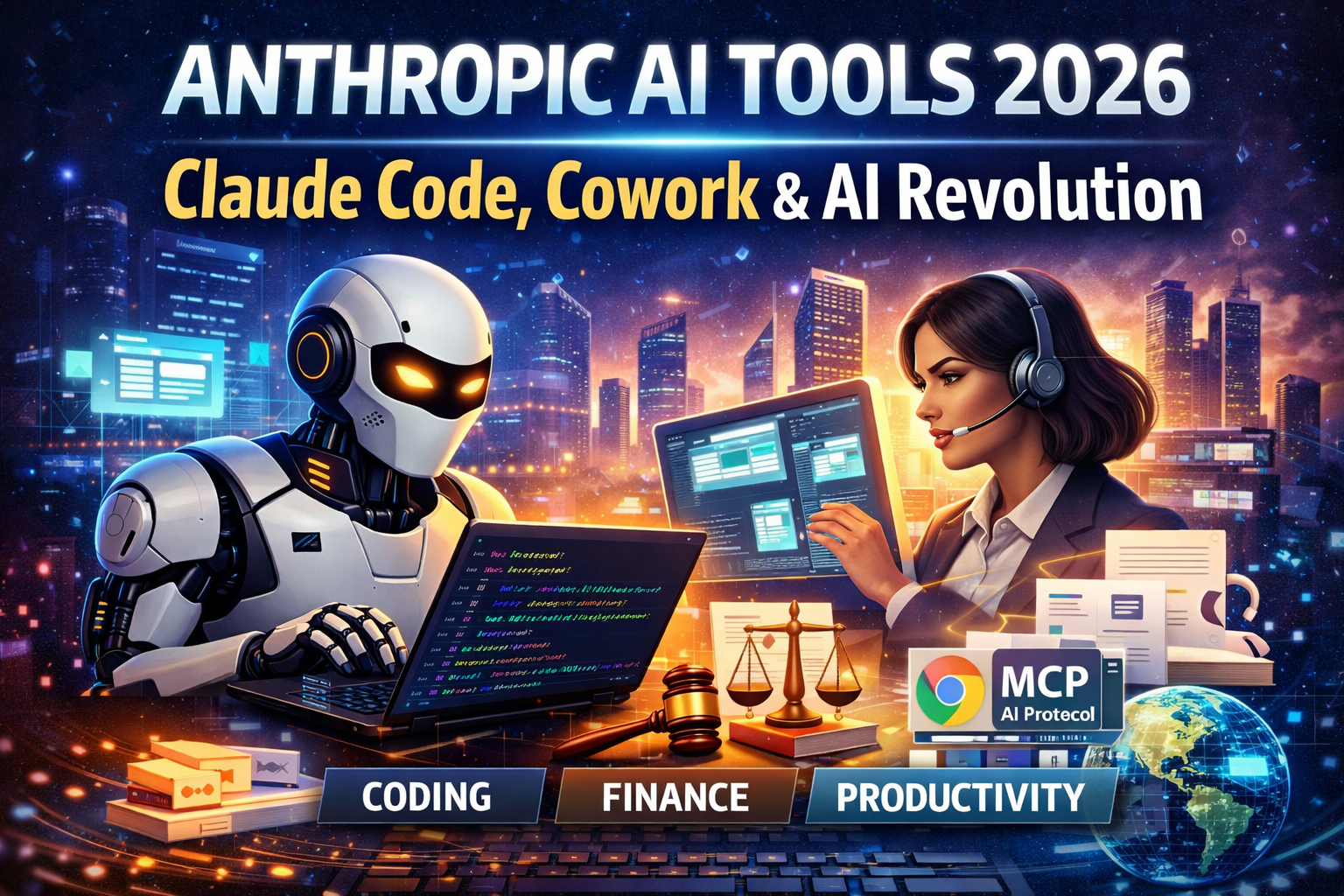
Anthropic AI Tools: The AI revolution just went nuclear as Anthropic’s Claude ecosystem – armed with game-changing tools like Claude Code, Claude Cowork, Claude in Chrome, and a jaw-dropping arsenal of enterprise plugins – has exploded onto the global tech scene in 2026, sending software stocks crashing $285 billion in a single day while rewriting what AI productivity means from Silicon Valley to Bangalore tech parks.
What started as a “safer AI” company founded by ex-OpenAI researchers in 2021 has morphed into a productivity juggernaut valued at $380 billion, shipping major updates every two weeks that disrupt legal, finance, cybersecurity, and coding industries faster than companies can adapt, all while maintaining safety principles that set them apart from reckless competitors.
Tech Twitter explodes with “SaaSpocalypse” warnings, LinkedIn buzzes with enterprise adoption stories, Reddit threads overflow with “Claude replaced my entire workflow” testimonials, and venture capitalists scramble to understand whether they should invest in or flee from software companies facing AI disruption – this isn’t just another AI tool launch, it’s a paradigm shift reshaping knowledge work itself in real-time.
From January through March 2026 alone, Anthropic has unleashed Claude Opus 4.6 with 1 million token context window, Claude Cowork that automates office work, Claude Code Security that found 500+ vulnerabilities in vetted open-source projects, industry-specific plugins for finance/legal/HR, and computer use capabilities on macOS – each release more disruptive than the last, proving AI progress isn’t slowing down; it’s accelerating exponentially.
Claude Code: The Developer’s New Best Friend
Claude Code grew from research preview to billion-dollar product in just six months, fundamentally changing how developers work worldwide. This isn’t glorified autocomplete – it’s an AI pair programmer that handles entire features, debugs complex issues, and reviews code with superhuman consistency.
Claude Code Review launched in March 2026, designed to catch bugs before they hit production codebases. The AI examines code changes step-by-step, labels severity using color codes (red for critical, yellow for warnings, purple for legacy issues), and provides fix suggestions that actually make sense.
Multiple agents work in parallel, each examining code from different perspectives, with a final agent aggregating findings and removing duplicates. For enterprise teams drowning in pull requests from AI-generated code, this is salvation.
But wait, there’s more – Claude Code now features “auto mode” in research preview, using AI safeguards to review each action before execution, checking for risky behavior and prompt injection attacks. The AI decides which actions are safe to execute autonomously versus what needs human approval. Currently works with Claude Sonnet 4.6 and Opus 4.6 only, recommended for isolated sandbox environments.
Developers at Anthropic itself now use Claude for approximately 60% of their work (up from 28% a year ago), reporting 50% productivity gains. The team ships 60-100 internal releases per day. When the tool builders rely on their own tool THIS heavily, you know it’s legitimate.
Indian developers from Bangalore to Pune are adopting Claude Code for everything from legacy COBOL modernization to React component generation, with freelancers on Upwork and Fiverr advertising “Claude-assisted development” as premium services commanding higher rates.
Claude Cowork: AI Colleague That Never Sleeps
Claude Cowork launched to be like an AI colleague, with ability to read files, organize folders, and draft documents on your behalf. Think Claude Code for knowledge workers – if developers got their productivity revolution, why shouldn’t lawyers, analysts, designers, and managers get theirs?
New plugins tailored for specific industries like sales, finance, data marketing, and legal launched, sending software stocks into spiral. Wall Street panicked that AI tools would challenge existing software companies’ data analytics and research products, potentially making traditional SaaS subscriptions obsolete.
A new AI automation tool from Anthropic sparked $285 billion rout in stocks across software, financial services, and asset management sectors in February 2026. Goldman Sachs’ software basket sank 6%, financial services tumbled 7%, Nasdaq 100 fell 2.4%. Thomson Reuters plunged 15.83% (biggest single-day drop on record), LegalZoom sank 19.68%.
But here’s the reality check – Companies can connect Claude Cowork to existing tools like Google Drive, Gmail, DocuSign, and FactSet, deploying customizable plugins across domains. This isn’t about replacing enterprise software; it’s about making existing tools 10x more powerful through AI orchestration.
Claude Code and Claude Cowork now execute tasks using users’ computers on macOS, including opening files, using web browsers, and running development tools. The AI prioritizes connections to supported services like Google Workspace and Slack, asking permission before performing actions. It’s productivity automation that actually respects user control.
Mumbai investment bankers, Delhi lawyers, Bangalore analysts – everyone’s testing Cowork plugins for their workflows, sharing prompts in WhatsApp groups, discovering use cases Anthropic never imagined.
Claude Models: The Brains Behind Everything
Claude Opus 4.6 is Anthropic’s most capable AI model as of early 2026, featuring 1,000,000-token context window, improved multi-step reasoning, and outperforming competing models on professional benchmarks in legal, financial, and coding tasks.
To put this in perspective – 1 million tokens = approximately 750,000 words = entire Harry Potter series + change. You can feed Claude Opus your company’s entire codebase, year of financial filings, or complete project documentation in ONE prompt and get intelligent analysis back.
Claude Sonnet 4.6 launched with full upgrade across coding, computer use, long-context reasoning, agent planning, knowledge work, and design. Sonnet balances speed and capability – it’s the workhorse model most users interact with daily for chat, coding assistance, and document analysis.
Claude Haiku (the fastest, cheapest model) handles high-volume tasks like customer support automation, content moderation, and data extraction where millisecond response times matter more than PhD-level reasoning.
The model lineup covers every use case: Opus for complex analysis requiring deep reasoning, Sonnet for everyday productivity that needs intelligence, Haiku for volume tasks demanding speed. Pricing scales accordingly – you’re not paying Opus rates for tasks Haiku handles perfectly.
Indian startups love this tiered approach – use expensive Opus only for critical business decisions, Sonnet for regular workflows, Haiku for customer chatbots. Smart cost optimization while maintaining quality.
Enterprise Plugins: Industry-Specific Superpowers
Anthropic unveiled enterprise agents program in February 2026, its most aggressive push yet to integrate agentic AI into everyday workplaces. Pre-built agents help with common enterprise tasks including financial research, engineering specifications, HR workflows, and design iteration.
New AI tools for Claude Cowork designed to automate work in fields including human resources, investment banking, and design, developed with partner companies like FactSet Research Systems. These aren’t generic chatbot responses – they’re industry-calibrated workflows encoding institutional knowledge and best practices.
The financial analysis plugin connects to FactSet data, enabling wealth managers to generate client reports analyzing portfolio performance against market benchmarks in minutes instead of hours. Equity research analysts pull comparable company data, build valuation models, and draft investment memos with AI assistance that understands financial terminology and regulatory requirements.
Legal plugins search case law, draft contract clauses, identify compliance risks in agreements – compressing days of paralegal work into hours while flagging issues human reviewers might miss. Delhi law firms and Mumbai corporate legal teams are early adopters, using plugins for due diligence that traditionally required armies of junior associates.
HR plugins screen resumes, draft job descriptions, analyze employee sentiment from surveys, generate onboarding documentation – automating repetitive tasks while surfacing insights buried in data. Bangalore’s booming HR-tech startup ecosystem integrates these capabilities into their products, offering “AI-powered talent management” that actually delivers value.
Anthropic made rapid updates including industry-specific tools for design, human resources, wealth management, plus integration with Microsoft Excel and PowerPoint apps. Claude in Excel reads spreadsheets with thousands of rows, creates pivot tables, applies conditional formatting, builds complex formulas – all through natural language commands. Claude in PowerPoint generates presentation slides, reformats layouts, suggests visualizations based on data.
These aren’t demos; they’re shipping products enterprises can deploy today with IT controls, data governance, and security standards corporate compliance teams demand.
Model Context Protocol (MCP): The Secret Weapon
Model Context Protocol (MCP) hit 100 million monthly downloads, becoming the industry standard for connecting AI to tools and data. This is the infrastructure layer nobody talks about but everyone will rely on.
MCP enables Claude to orchestrate across GitHub, databases, documentation systems, cloud infrastructure, legal review pipelines – using native skills for each platform without custom integration code for every tool. It’s the Unix pipes philosophy applied to AI workflows.
Tool Search Tool allows Claude to dynamically discover tools instead of loading all definitions upfront, representing 85% reduction in token usage while maintaining access to full tool library. Internal testing showed Opus 4 improving from 49% to 74% accuracy on MCP evaluations with large tool libraries.
For developers, this means building AI agents that connect to ANY data source or API becomes dramatically simpler. For enterprises, it means Claude integrates into existing tech stacks without rip-and-replace migrations. For users, it means seamless experiences where AI “just works” across their tools.
Indian SaaS companies building on MCP gain competitive advantages – faster time-to-market, better AI integration, access to Anthropic’s ecosystem of partners and developers.
Claude in Chrome & Desktop: AI Where You Work
Claude in Chrome launched as browsing agent alongside Skills and Cowork as desktop tools bringing Claude’s agentic capabilities to where users actually work. No more context-switching between browser tabs and AI chat interfaces – Claude lives in your workflow.
The Chrome extension reads webpage content, summarizes articles, extracts data into structured formats, fills out forms, compares products across sites – all while you browse normally. It’s like having a research assistant who never gets tired, never complains about tedious tasks, and works at inhuman speed.
Desktop capabilities on macOS mean Claude can open files, manipulate documents, control applications, automate repetitive tasks – essentially functioning as your personal automation engineer who understands natural language instructions.
For students in Indian colleges juggling research papers, freelancers managing client projects, startup founders wearing fifteen hats simultaneously – these tools compress hours of manual work into minutes of AI-assisted productivity.
Claude Code Security: Finding Bugs Humans Miss
Claude Code Security reasons about code the way human security researchers would, tracing data flows across entire codebases, looking for logic flaws that cross file boundaries. Traditional security tools match known-bad patterns; Claude understands intent and context.
In testing with Opus 4.6, Anthropic’s security team found over 500 vulnerabilities in well-reviewed open-source projects, including bugs undetected for years. One example was a decades-old bug in Ghostscript PDF engine requiring reasoning over commit history that static analysis tools missed entirely.
When Claude Code Security launched, cybersecurity stocks tanked – CrowdStrike dropped 15%, Okta 12%, Zscaler 11%. Investors fear AI security analysis could render traditional tools obsolete or dramatically reduce their pricing power.
For companies building software, this is game-changing – automated security reviews that catch critical vulnerabilities before production deployment, saving millions in potential breach costs and reputational damage. Indian IT services companies offering security audits integrate these capabilities to deliver faster, more comprehensive assessments than human-only teams.
Real-World Impact: Who’s Actually Using This?
Anthropic partnered with Teach For All to bring AI tools and training to educators in 63 countries, with over 100,000 teachers developing AI fluency and adapting Claude for classroom needs. One teacher in Liberia built interactive climate education curriculum for Liberian schools using Claude Artifacts within weeks of learning the tool.
Enterprise adoption exploded across sectors. Financial institutions use Claude for regulatory compliance reviews, contract analysis, client report generation. Law firms deploy it for legal research, due diligence, document drafting. Healthcare organizations apply it to medical literature reviews, clinical documentation, patient communication.
Claude Code revenue grew 5.5x between Q1 and Q3 2025, with Claude Enterprise providing 500,000 token context windows enabling use cases like processing entire year of financial filings or 300-file codebase in single prompt.
Startups in Bangalore’s Koramangala, Mumbai’s Powai, Pune’s Hinjewadi, Delhi’s Gurgaon – everywhere you look, founding teams use Claude to ship products faster with leaner teams. Solo founders build features that previously required engineering teams. Small agencies compete with established firms by leveraging AI productivity multipliers.
The pattern is consistent globally – early adopters who master these tools gain 2-3x productivity advantages over competitors still doing everything manually. This isn’t hype; it’s measurable competitive differentiation showing up in time-to-market, cost structures, and output quality.
Pricing: Enterprise Value, Startup Accessible
Claude Pro at $20/month includes extended thinking, full Claude Code access, and Cowork preview – delivering more capability per dollar than any comparable AI subscription. For individual professionals and small teams, it’s absurdly affordable productivity insurance.
Claude Max (higher tier) makes sense only for power users running Opus 4.6 as their primary work tool – think developers shipping production code daily, analysts processing massive datasets, researchers working with extensive documentation.
Enterprise plans provide dedicated capacity, priority support, admin controls, custom training, and SLA guarantees. Pricing negotiated based on usage volume – but the value proposition is clear when single analyst using Claude Opus can process work previously requiring three-person team.
API pricing follows token-based model with three tiers matching model capabilities. Prompt caching feature provides 70-80% cost savings for applications making repeated calls with similar context – crucial for production deployments at scale.
Indian rupee pricing makes these tools accessible to broader audience than Silicon Valley wages assume. Students afford Pro plans splitting subscriptions, freelancers justify costs from single client project, startups scale usage as revenue grows.
The Disruption Nobody’s Talking About
Anthropic CEO Dario Amodei warned AI will cause “unusually painful” disruption to jobs, arguing “AI could displace half of all entry-level white-collar jobs in next 1-5 years”. This isn’t fear-mongering; it’s honest assessment from someone building the technology.
Marc Benioff, CEO of Salesforce, told Fortune the company won’t be hiring any additional software engineers, customer service agents, or lawyers because of AI tools. When Fortune 500 CEOs openly state they’re not hiring entire categories of workers, the disruption is real and immediate.
But history suggests technology creates more jobs than it destroys – just different ones. The question is whether displaced workers can transition to newly created roles fast enough, and whether institutions provide support for those transitions.
Companies that figure out Claude as orchestration layer instead of just smart autocomplete will have significant workflow advantages by end of 2026. That’s the real competitive moat – not raw AI capability (which commodifies quickly), but organizational capability to integrate AI into every workflow, retrain teams, redesign processes.
Indian IT services industry faces existential question – how to maintain margins when clients can accomplish more with fewer offshore developers using AI tools? Answer likely involves moving up value chain to AI strategy consulting, custom model training, integration services, change management – work that can’t be easily automated.
Why Anthropic Stands Apart
Safety isn’t marketing fluff for Anthropic – it’s foundational. The company restricts Claude from use in lethal autonomous weapons or domestic surveillance, even when that costs government contracts. When Pentagon demanded unrestricted access threatening $200 million deal and federal blacklisting, Anthropic faced genuine ethical dilemma versus competitors who’d cave instantly.
Constitutional AI training methodology, mechanistic interpretability research, responsible scaling policies, transparent safety disclosures – these aren’t checkbox exercises. They’re serious attempts to ensure powerful AI systems remain beneficial as capabilities grow.
For enterprise customers, this translates to predictable behavior, fewer hallucinations, better alignment with instructions, clearer explanations when Claude can’t help with something. Technical excellence plus safety culture creates reliability that production systems demand.
Consumer market share lags ChatGPT (which dominates with 64.5% of AI chatbot traffic versus Claude’s smaller slice), but enterprise adoption tells different story – companies need reliable, safe, controllable AI integrated into mission-critical workflows, not flashy demos.
What Comes Next
Anthropic launched Labs team focused on incubating experimental products at frontier of Claude’s capabilities, with Instagram co-founder Mike Krieger joining to build alongside the team. When proven product leaders from successful consumer platforms join AI infrastructure companies, expect major consumer-facing launches ahead.
Persistent memory rolled out to all users including free tier in March 2026 – Claude now retains your preferences, writing style, project context across separate conversations. ChatGPT had this for paid users since 2024; Anthropic gave it to everyone with full transparency controls.
Mobile app expansions announced March 26, 2026 integrate work tools like Figma, Canva, Amplitude dashboards – enabling users to access designs, analytics, create presentations from phones. Rumored “Orbit” smartphone-access capability could bring desktop-class AI experiences to mobile.
The release cadence collapsed from months to weeks to days in some cases. Anthropic ships 60-100 internal releases per day using its own tools, with each new Claude model making it faster to build the next one. This is recursive improvement – AI accelerating AI development.
Grab Your Seat Before the Train Leaves
These aren’t vaporware announcements or research papers. Claude’s tools are shipping products millions use daily, generating billions in revenue, disrupting trillion-dollar industries, fundamentally restructuring knowledge work.
Early adopters gain compounding advantages – they learn the tools faster, discover unique applications, build competitive moats before competitors wake up. Late adopters scramble playing catch-up while their margins compress.
For developers: Claude Code is your productivity multiplier. For analysts: Enterprise plugins are your force multiplier. For students: Pro subscription is your career insurance. For founders: MCP integration is your differentiation.
The Anthropic AI tools ecosystem isn’t just another software suite – it’s the infrastructure layer for how knowledge work happens in the AI age. Master it now, or watch competitors who did eat your lunch.
Pricing is accessible, capabilities are proven, adoption is exploding, disruption is measurable. The question isn’t whether to use these tools. The question is how fast you can integrate them before your competition does.